POCOPOCO JOURNAL
Before you begin: four checks for a crochet pattern
Pause before picking up your hook to check the terms, materials, gauge and repeats. A small reading guide for approaching an unfamiliar pattern.
About a 3-minute read
You have found something you would love to make, but the pattern opens with a page of symbols and numbers. Where do you begin? Before working the first row, look for the information you will need along the way. You do not have to memorise the whole pattern. Think of this as finding the places you can return to when a question comes up. These four checks can help you approach crochet charts and written instructions with a clearer starting point.
Start with the pattern's own terminology
English-language patterns may use US or UK crochet terms, and the same stitch has different names in the two systems. For example, US single crochet (sc) corresponds to UK double crochet (dc). Do not assume a familiar abbreviation means the stitch you expect. Find the stated system and abbreviation key, then check the pattern's definitions of special stitches and chart symbols. If you consult a video or another reference, make sure its terminology matches. A sticky note with just the unfamiliar terms can save you from searching the full list repeatedly.
Read materials and finished size together
Find the size you want to make and the yarn and tools listed for it. If instructions show several sizes, choose and mark the numbers you will follow before you begin. Lay out your yarn and hook and compare them with the materials list. If you want to substitute yarn, similar appearance alone does not establish the same result: move on to the gauge information. Mark any preparation details you cannot yet resolve, and consult the designer's or seller's guidance before proceeding.
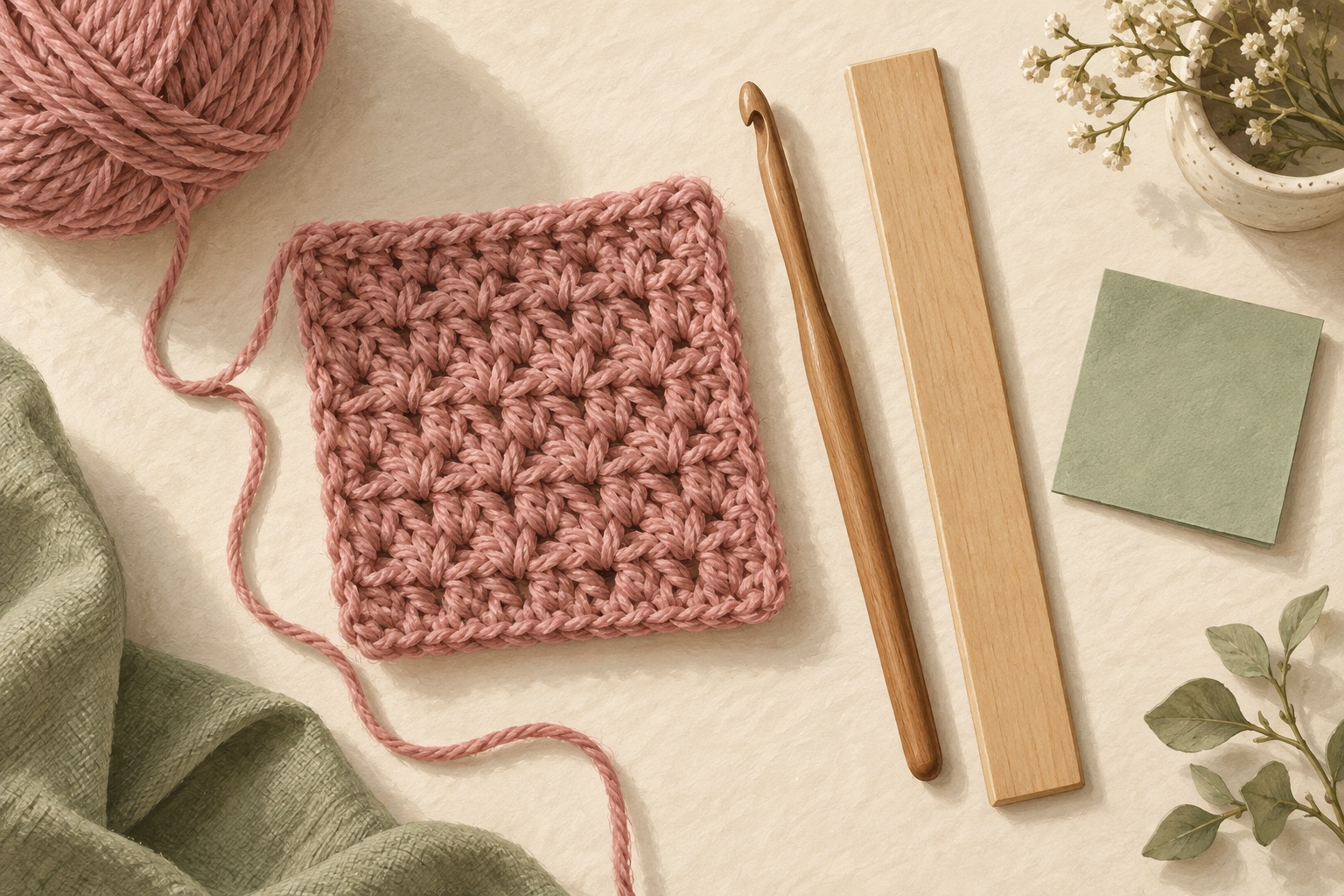
AI-generated illustration, not a gauge measurement or stitch guide. Follow your pattern's instructions for swatching. Treat gauge separately from hook size
Gauge describes the number of stitches and rows within a stated width and height. A listed hook size does not establish that your fabric will match the specified gauge. When the pattern gives swatch instructions, use its specified yarn, hook and stitch pattern, and follow its directions for measuring and finishing the sample. There is no universal swatch dimension prescribed here. Especially for something you will wear, reviewing both gauge and finished measurements before starting the main piece gives you information for your decisions.
Trace the beginning and end of each repeat
Asterisks and brackets can mark repeated instructions in written patterns. Parentheses can also have other uses, such as grouping stitches worked into one stitch. Read the surrounding words and notes instead of assuming every bracket means a repeat. Read the whole row you plan to work, finding where a repeat starts, where it ends and how many times it is worked. A stitch count at the end may state the row's total rather than ask for additional stitches. Pausing over an unclear instruction is useful preparation too.